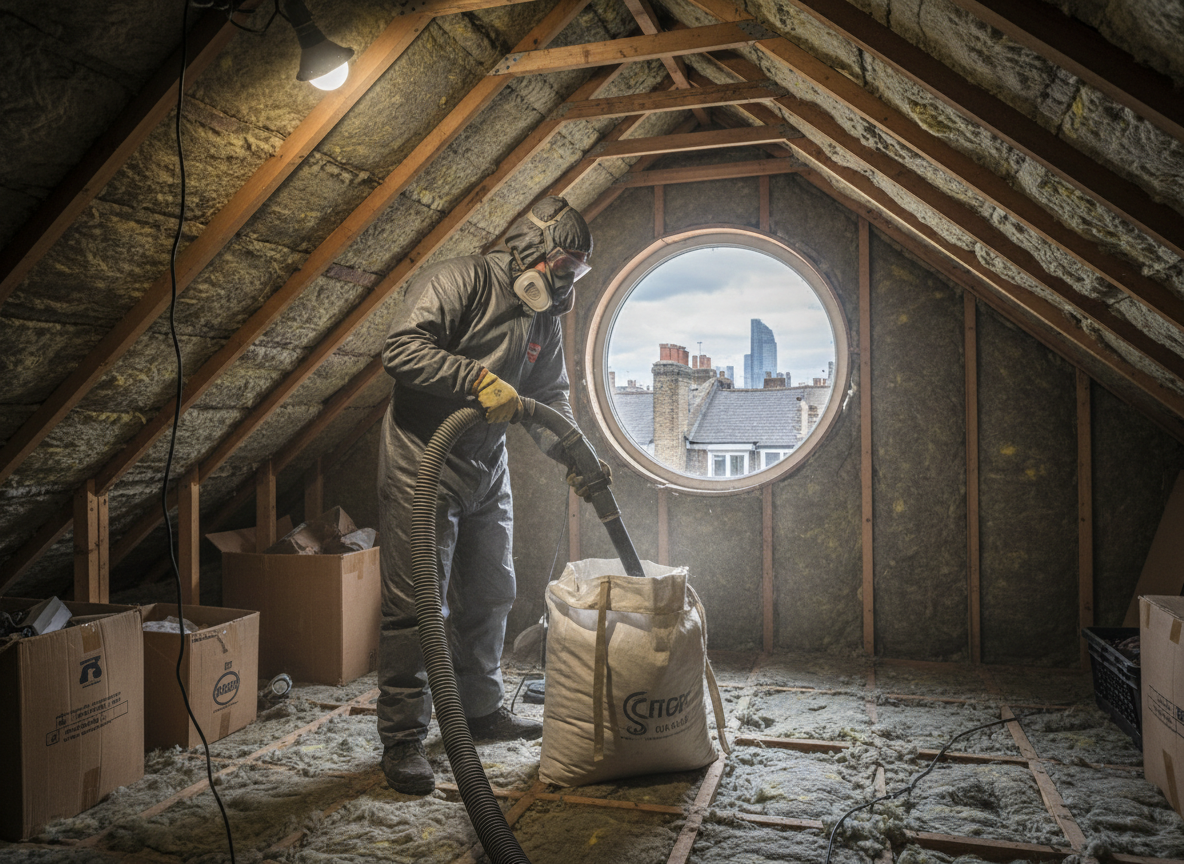
Spray foam insulation removal in London often involves older Victorian terraces and Edwardian semis in areas like Islington and Camden where closed-cell foam was injected into cavity walls decades ago. These installations trap moisture against brickwork that already faces high rainfall, leading to timber decay and reduced airflow in roof voids. Removal requires careful cutting and vacuum extraction to avoid disturbing original lath and plaster ceilings common in N7 postcodes.
Edge cases include listed buildings around Highgate and Hampstead where foam bonds tightly to historic timbers, demanding slower hand removal rather than aggressive scraping. Building regulations in Greater London require waste to be disposed through licensed carriers, and we separate foam from any underlying mineral wool layers that may still meet current standards. Homeowners in flood-prone zones near the Thames should note that foam can hide water damage until extraction begins.
Weather patterns affect timing, as persistent damp from autumn through spring makes foam more pliable but increases slip risk on pitched roofs in outer boroughs like Barnet. We always check for asbestos in pre-1980 lofts before starting, a frequent find in London stock. Proper ventilation restoration after removal prevents condensation issues that arise once the foam's airtight seal is gone.
Technician insight
In London, the thing that catches most people out with insulation removal service is how often closed-cell foam in 1930s semis has bonded directly to original rafters in roof spaces that already have poor airflow from decades of urban pollution and rain. Homeowners assume a quick peel will do it, but the foam pulls away in stubborn sheets that leave residue on lath, and you have to stop and hand-scrape every few metres or you damage the ceiling below.
Foam removal in a N7 terrace loft
A homeowner in a 1920s Islington terrace noticed musty smells after heavy winter rain. We found closed-cell spray foam fully filling the loft void and trapping moisture against rafters. Extraction revealed hidden rot on two joists; we removed the foam, cleared the debris, and opened up the original vents before leaving the space dry and ventilated.
How it works
- 1
Site Assessment
Inspect loft and wall cavities in the London property to map foam depth and identify any hidden timber or wiring risks.
- 2
Containment Setup
Seal work areas with dust barriers to protect living spaces in terraced homes where shared walls are common.
- 3
Foam Extraction
Cut and vacuum remove the spray foam layer by layer, preserving original roof structures in N7 and surrounding postcodes.
- 4
Clearance and Disposal
Remove all debris and arrange licensed waste haulage before restoring ventilation paths.
- 5
Final Inspection
Check for remaining residue and confirm the space meets airflow requirements for the building's age.
Pricing
Cost depends on property age, foam thickness and access difficulty in London terraces; we provide upfront quotes after inspection.