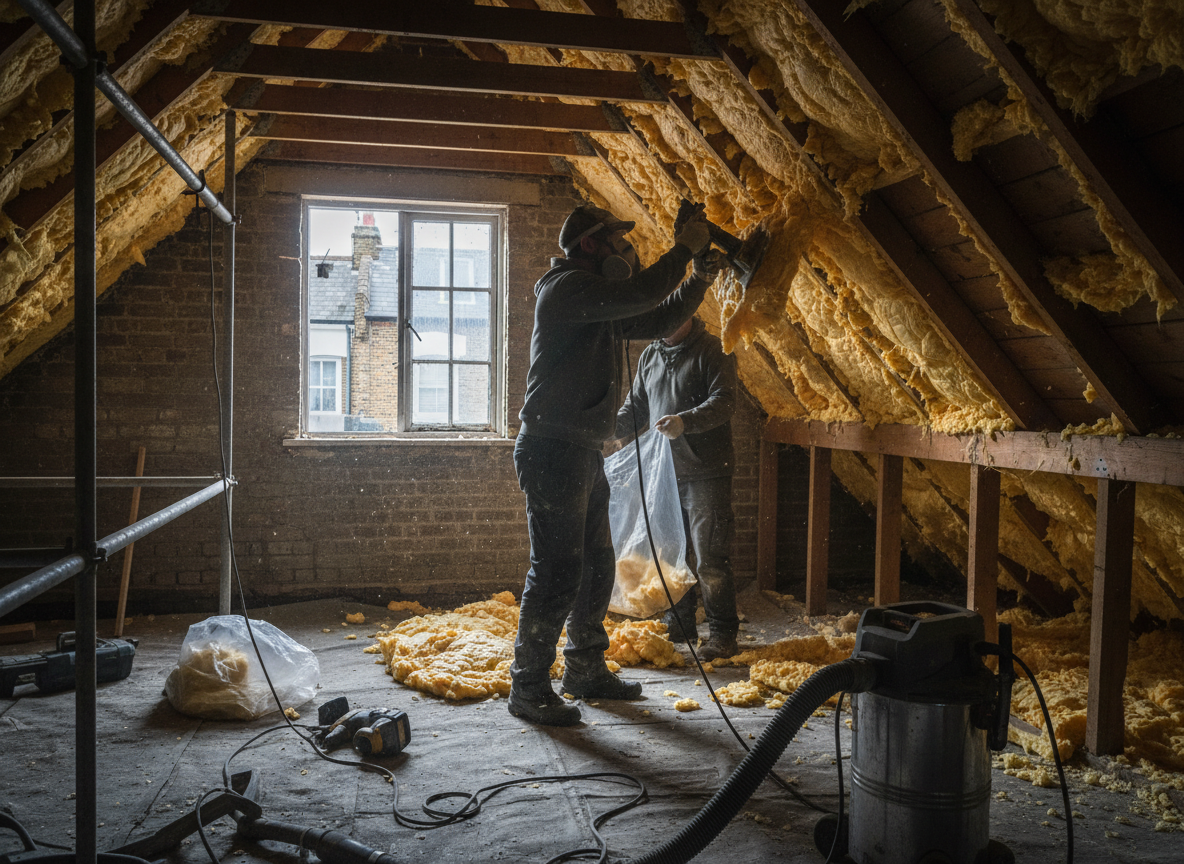
London's Victorian and Edwardian terraces around N7 and Islington often received spray foam in lofts during the 2000s energy push. The closed-cell material bonds tightly to rafters and can trap condensation from the area's frequent rain and mild winters, leading to timber decay that only appears once ceilings stain or mould returns. Removal requires careful separation from original lath and plaster without disturbing asbestos-containing artex common in these homes.
Greater London weather cycles, with heavy autumn downpours followed by cold snaps, accelerate moisture issues behind foam in properties near the Regent's Canal or on clay-heavy ground. Homeowners in Camden and Hackney frequently discover the foam was applied over existing felt that has since failed, turning a simple insulation upgrade into a full roof deck repair once the material is stripped.
Edge cases include semi-detached houses where party-wall foam migrates into neighbouring lofts, requiring coordination with adjacent owners, and basement conversions where spray foam was used on walls below ground level. Proper negative-air containment and HEPA filtration are essential because disturbing aged foam releases particulates that linger in the tight layouts typical of N7 terraces.
Regulatory notes for London jobs include checking for listed-building consent when working on pre-1919 stock and ensuring ventilation upgrades meet current Building Regulations Part F after foam is removed. We always inspect for original roof timbers weakened by previous water ingress before any cutting begins.
Technician insight
In London, the thing that catches most people out with Spray Foam Removal near me is how quickly closed-cell foam hides rot in the rafters of 1890s terraces around N7 once Thames-influenced damp gets trapped behind it.
Islington Terrace Loft
Homeowner in a Victorian terrace near Caledonian Road noticed ceiling stains after heavy winter rain. We found spray foam applied directly over failed felt, with widespread joist decay underneath. After contained removal and debris extraction we left the loft clear for new insulation and ventilation upgrades.
How it works
- 1
Site Assessment
Inspect loft or wall cavities in the N7 property, identify foam type and any hidden timber damage from London damp cycles.
- 2
Containment Setup
Install negative pressure and dust barriers to protect living spaces in terraced houses where party walls share air.
- 3
Mechanical Removal
Cut and peel foam from rafters and joists using specialist tools that avoid disturbing original lath and plaster.
- 4
Cleanup and Ventilation Check
HEPA vacuum residues, assess remaining roof structure, and advise on improved ventilation suited to Greater London conditions.
- 5
Final Inspection
Walk-through with homeowner confirming all foam is gone and no new moisture paths created.
Pricing
Upfront quotes after on-site inspection; cost varies with access difficulty and extent of hidden timber issues common in older London stock.