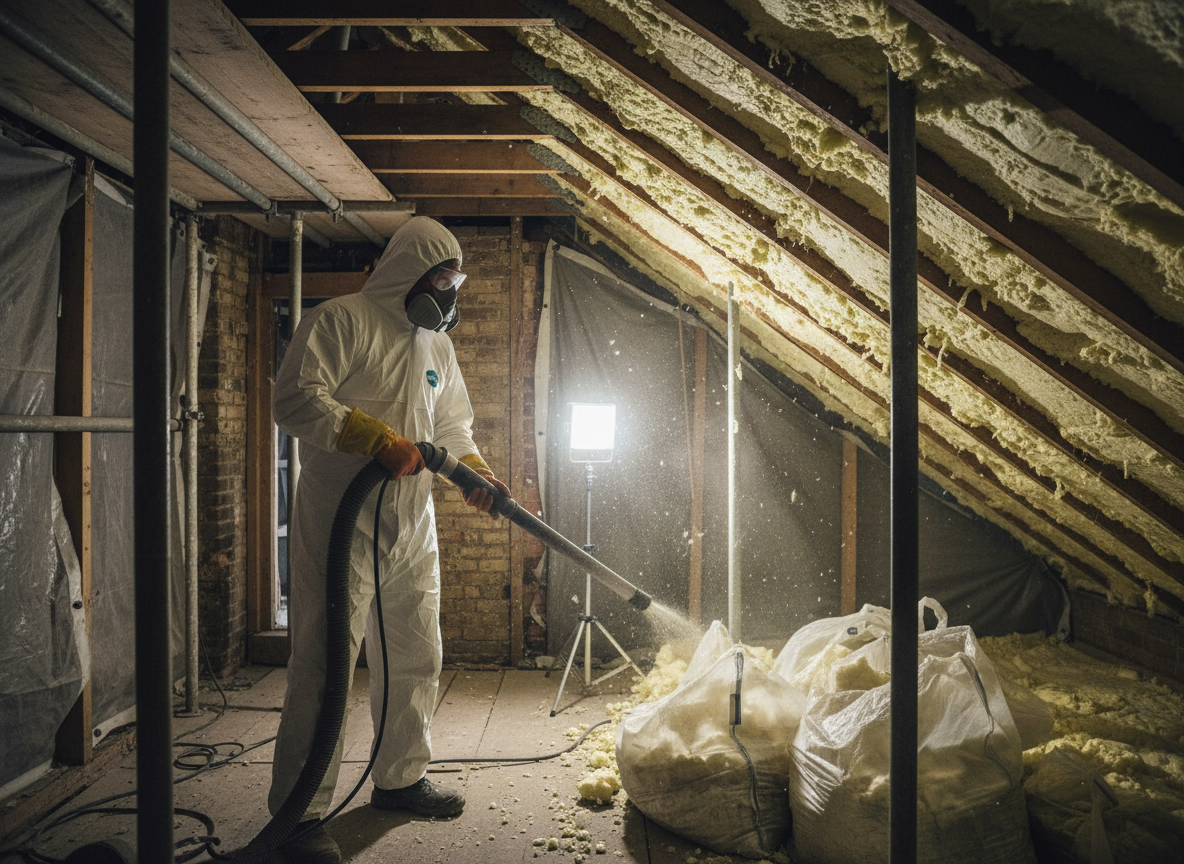
Open cell spray foam was widely applied in London lofts during the 2000s and 2010s to improve energy efficiency in Victorian and Edwardian terraces across Islington, Camden and Hackney. Unlike closed cell, the open cell variant remains flexible and permeable, allowing it to trap condensation from the city’s frequent damp winters and poor ventilation in older roof voids. Over time this leads to mould growth on rafters and joists, reduced airflow, and in some cases sagging ceilings where the foam has pulled away from lath and plaster. Removal requires careful mechanical cutting followed by vacuum extraction to avoid disturbing historic timber or asbestos-containing materials common in pre-1940 stock.
Homeowners in Greater London often discover the need for removal when selling or after a leak, as mortgage lenders now flag open cell foam in surveys. The work must respect building regulations on ventilation and fire separation, particularly in terraced properties where party walls limit access. Technicians based at 1 Hillmarton Rd work from the street or rear gardens, using dust containment to protect neighbouring homes. Disposal follows Environment Agency rules for expanding foam waste, which cannot be mixed with general construction rubble.
Edge cases include foam injected into cavity walls of 1930s semis in areas like Enfield and Waltham Forest, where removal risks damaging brick ties or insulation boards already present. In these situations, borescope inspection precedes any cutting. Summer jobs move faster because lower humidity reduces dust cling, while winter work requires extra drying time before new insulation can be installed. Every project starts with a full loft survey to map wiring, pipework and insulation depth before any material is disturbed.
Technician insight
In London, the thing that catches most people out with open cell spray foam removal is the way Victorian terraces in Islington and Camden often have the foam sprayed directly onto lath and plaster ceilings that are already fragile. One missed section behind a chimney breast and you get callbacks months later when mould reappears.
Hackney Loft Clearance
A 1905 terrace owner called after a winter leak stained the bedroom ceiling. Inspection showed open cell foam saturated above the bathroom. We removed the foam in two days, cleaned the rafters, and restored airflow so the ceiling could dry without further damage.
How it works
- 1
Site Survey and Access Check
Technicians inspect the loft or cavity from the N7 base or on-site, checking for asbestos, wiring and structural timber condition before quoting.
- 2
Containment and Dust Control
Plastic sheeting and negative air machines are set up to protect living areas and neighbouring properties common in London terraces.
- 3
Mechanical Removal
Open cell foam is cut and vacuumed in sections, with rafters cleaned of residue to restore original ventilation paths.
- 4
Waste Disposal and Final Clean
All material is bagged for licensed disposal; the space is HEPA vacuumed and left ready for re-inspection or new insulation.
Pricing
Cost depends on loft size, foam depth and access difficulty typical of London terraces; quotes are provided after survey.