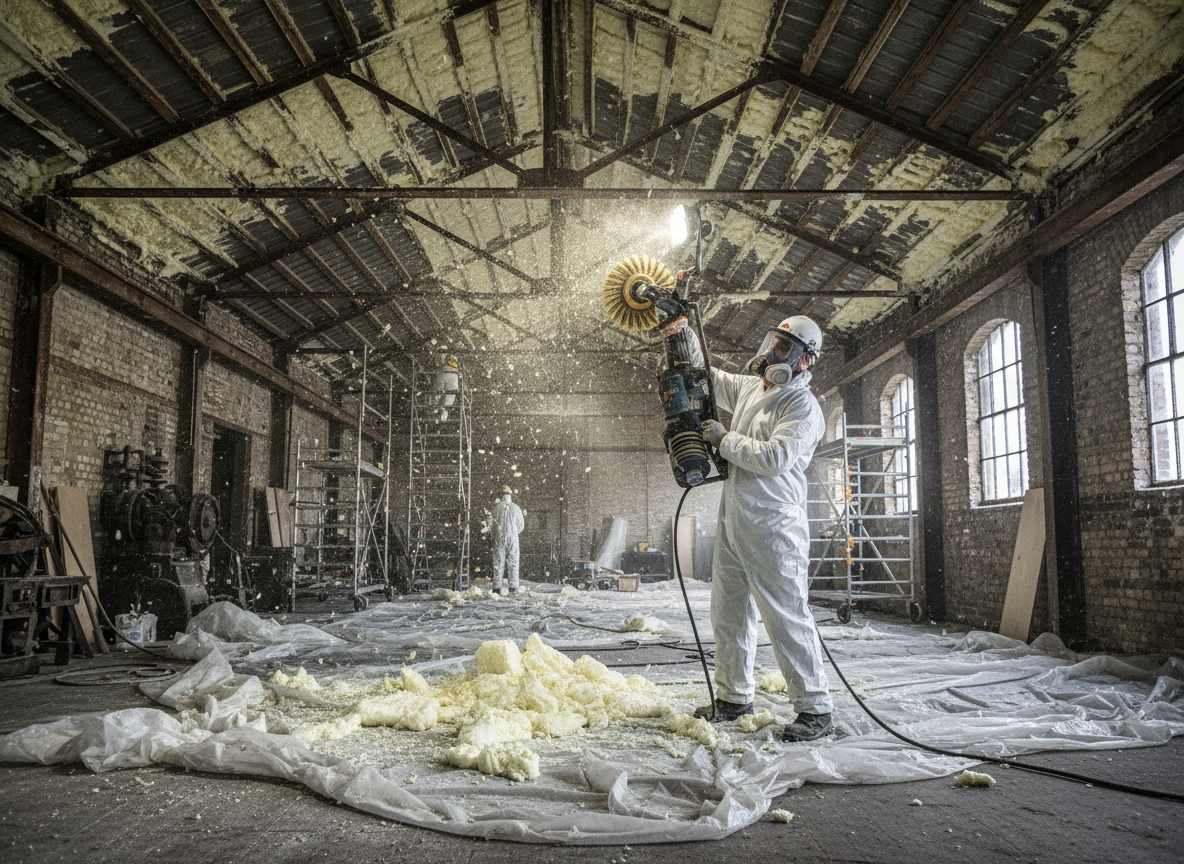
Warehouses in London often feature spray foam applied to metal roofs and brick walls in estates around Islington, Hackney and the Lea Valley. Removal requires cutting through multiple layers without damaging steel purlins or electrical runs that were installed before current building standards. Crews must contain dust and off-gassing in enclosed spaces where ventilation is limited by the original design.
Older stock from the 1960s and 1970s frequently has foam bonded directly to asbestos-containing boards or bitumen, common in buildings near the Regent’s Canal and railway arches. Safe separation demands negative-pressure setups and licensed waste carriers to comply with Greater London Authority disposal rules. Incomplete removal leaves residue that attracts moisture and accelerates corrosion on metal decking.
Access in dense London locations is restricted by narrow service roads and shared yards. Equipment must be broken down and carried through standard personnel doors rather than relying on large plant. Weather delays are routine because sudden rain on flat roofs can flood the workspace before membranes are reinstated.
Final clearance involves independent air testing and photographic records of exposed surfaces so the building owner can proceed with new insulation or racking installation without hidden defects.
Technician insight
In London the thing that catches most people out with warehouse spray foam removal is the hidden second layer applied over the first in buildings from the 1970s around the canal basins and railway yards. That extra layer bonds to bitumen and old wiring, so the job always takes longer than the drawings suggest and you cannot rush the separation without pulling down the original roof fixings.
East London warehouse roof
Foam on a 1970s steel portal frame warehouse had been topped up twice, trapping condensation against the purlins. We found the lower layer adhered to original bitumen felt. We stripped both layers under negative pressure, cleared the residue without disturbing the asbestos flashings, and left the metal deck ready for new lining.
How it works
- 1
Site Survey and Testing
Measure foam depth, locate services and check for hazardous materials before any work begins.
- 2
Containment Setup
Install negative air machines and floor protection to isolate the work zone from the rest of the warehouse.
- 3
Mechanical Removal
Cut and peel foam in sections, bagging material on site to prevent spread.
- 4
Surface Cleaning and Disposal
Scrape residue, vacuum surfaces and load waste for licensed transfer to approved facilities.
- 5
Final Verification
Conduct air quality checks and provide documentation for the building owner.
Pricing
Pricing is determined after on-site inspection; factors include foam thickness, access constraints and waste volume.